Pregnancy
0 min read
Can twins cause false negative pregnancy test?

Medically Reviewed Haley Genovese, MD, Reproductive Endocrinologist at IVI RMA North America
Written by Cradlewise Staff
A negative pregnancy test can be confusing, especially if your period is late or you’re noticing pregnancy symptoms. And if you’re wondering whether twins could be the reason, the answer is: rarely, yes.
Here’s why it can happen, how rare it is, and what to do next if your test is negative but something still feels off.
We consulted Dr. Haley Genovese, MD, Reproductive Endocrinologist at IVI RMA North America, and Dr Jody-Ann McLean, MBBCh, BSc, with an expertise in women’s hormonal and metabolic health, who have shared their useful insights.

Cradlewise Smart Crib
Smarter Sleep for Your Baby
An award-winning crib—loved by parents, approved by experts.
0 to 24 months of use
Automatic soothing
Built-in video & sound machine
AI-powered sleep insights
Customizable soundtracks
Get 2 extra hours of sleep nightly
Can twins cause a false negative pregnancy test?
Yes, in rare cases twins can cause a false negative pregnancy test through a phenomenon called the hook effect, where extremely high hCG levels overwhelm the test’s antibody system and produce a false negative.
What is the hook effect
The hook effect is what happens when there are high hCG levels. Extremely high levels of hCG can prevent the antibodies from binding correctly and forming the reaction that would show as a positive line. The test becomes overwhelmed, fails to register correctly, and reads as negative. This is the hook effect.
How common is the hook effect in twin pregnancies
Dr Jody-Ann McLean concurs, “The ‘hook effect’ otherwise called ‘prozone phenomenon’ is very rare. I don’t think many clinicians encounter this very often.”
The hook effect is most commonly discussed in the context of gestational trophoblastic disease, which is a group of tumors where abnormal cells grow in the uterus in a rare, abnormal pregnancy (only 0.1% of pregnancies), and where hCG levels can reach into the millions.
Cradlewise Note: In a straightforward twin pregnancy, the hook effect is an interesting piece of information to know rather than something to factor into your testing plan.
How pregnancy tests detect hCG
Home pregnancy tests work by detecting levels of human Chorionic Gonadotropin hCG through a urine test. HCG is the hormone your body produces after a fertilised egg implants in your uterus.
HCG levels increase when you become pregnant and often double every 48-72 hours in the first few weeks. And it is the reason why timing affects when you take an early pregnancy test.
If you test too early, the result will be negative as there are less than 5 mIU/mL of hCG present in your urine, which is typically the case with a non-pregnant woman. For the result to be positive, there needs to be at least 25 mIU/ml of hCG present in your urine.
Blood test vs. urine test: Which is more reliable?
A home urine test gives you a yes or no answer based on whether hCG crosses a detection threshold. A blood test measures the exact concentration of hCG in your blood.
Dr. Haley Genovese says in case the hook effect is suspected, a lab may resort to serial dilution to decrease the amount of hCG in the test, in order to correct it.
However, Dr Jody-Ann McLean clarifies, “Labs don’t necessarily dilute blood samples even if the hCG is very high, because the hook effect is very rare. It usually needs to be clinically suspected, for example if there’s a mismatch between strong clinical signs that the patient is pregnant and then the pregnancy test shows negative, then it could be requested rather than done automatically.”
What is the difference in hCG levels of Singletons vs. Twins
Dr. Genovese says, “A twin pregnancy should typically produce peak hCG levels of ~200,000 at most, and we don’t expect to have true concerns about the hook effect unless hCG is at least 500,000.”
While a twin pregnancy produces higher hCG than a singleton, the threshold for the hook effect (500,000+ mIU/mL) is much higher still. As Dr. Genovese explains, the gap is rarely closed in healthy multiple pregnancies.
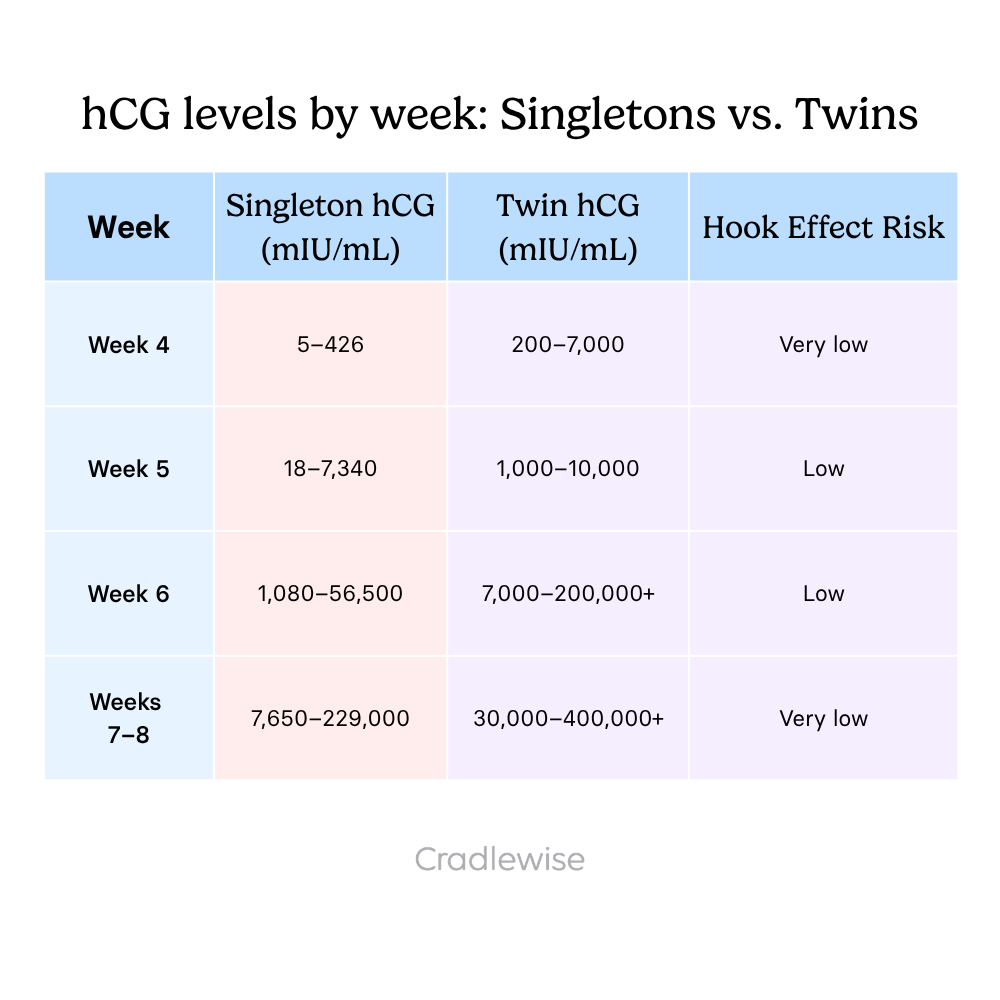
Sources: American Pregnancy Association and MidWest Fertility Center
Note: hCG level alone cannot confirm or rule out a twin pregnancy. Only an ultrasound can do that. The table above is for context and reassurance.
What else can cause a false negative pregnancy test
The hook effect is the rarest explanation for a false negative. These are much more common ones:
- Testing too early: hCG may not be detectable until 10-14 days after conception, even with a sensitive test. Implantation itself can take 6-12 days after fertilization.
- Testing at the wrong time of day: Afternoon or evening urine is more diluted. First morning urine gives the most reliable result.
- Diluted urine: Drinking a lot of fluids before testing can lower hCG concentration below the detection threshold.
- Faulty or expired test: Always check the expiry date and store tests correctly (room temperature, away from moisture).
- Chemical pregnancy: An early pregnancy that ends very shortly after implantation may produce a brief hCG rise and then a negative result as levels fall.
What to do if you think you are pregnant but the test is negative
Getting a negative result when you feel pregnant is unsettling.
“ Most commonly, a negative test means that you are not pregnant. Symptoms of early pregnancy very closely mimic symptoms associated with high progesterone, so often when patients experience early pregnancy symptoms but have a negative test, they ovulated later than they originally thought and their period is just a little delayed. Sometimes they may truly be pregnant that cycle, but just need to wait a few more days to test again.”
Here’s what you can do:
- Wait 2-3 days and retest. The most common reason for a false negative is testing too early. hCG doubles roughly every 48-72 hours in early pregnancy, hence a test taken a few days later may give a very different result.
- Use first morning urine. hCG is most concentrated in your first urine of the day. Testing later in the day, especially with high fluid intake, can dilute the sample enough to affect the result.
- Try a different test brand. Different tests have different sensitivity thresholds. In case there is a true hook effect, a less sensitive test may show a positive where a highly sensitive one does not.
- Request a quantitative blood test. It measures your exact hCG levels in your blood (no worrying about the threshold problem) and gives you clear results.
When to call your provider
If you are experiencing significant one-sided pain, heavy bleeding, or dizziness alongside a negative test, call your provider immediately regardless of what the test says.
Cradlewise Smart Crib
Smarter Sleep for Your Baby
An award-winning crib—loved by parents, approved by experts.
0 to 24 months of use
Automatic soothing
Built-in video & sound machine
AI-powered sleep insights
Customizable soundtracks
Get 2 extra hours of sleep nightly
Conclusion
While it seems surprising, technically twins can cause a false negative pregnancy test through the hook effect. But in a healthy twin pregnancy, the hCG levels required to trigger it are rarely reached.
The hook effect is a real phenomenon, but it’s not something most people expecting twins need to worry about.
If you have a negative test and strong pregnancy symptoms, the most likely explanation is timing, not the hook effect. Wait a few days, retest with first morning urine, and if doubt persists, ask your provider for a quantitative blood test to remove all ambiguity.
FAQs
Q: Can twins cause a false negative pregnancy test?
A: Yes, in rare cases, through a phenomenon called the hook effect, where extremely high hCG levels overwhelm the test’s antibody system and produce a false negative.
Q: What is the hook effect?
A: The hook effect occurs when hCG is so high that it saturates both sides of the antibody complex in a test strip, preventing the antibodies from binding correctly. The result is a false negative – the test cannot register the pregnancy despite hCG being present.
Q: Should I take a blood test if I think I’m having twins?
A: If you have a negative urine test but strong pregnancy symptoms, a quantitative blood test (beta-hCG) is the most definitive step as it measures your exact hCG level rather than giving a yes/no threshold result.
Q: Can twins cause false negative pregnancy test at 4 weeks?
A: Yes, it is possible to have a false negative test at 4 weeks. It can be due to the hook effect, but that’s rare. It is most likely because you are testing too early, not using first-morning urine, using an expired kit to test, or your urine is too diluted to show correct results.
Q: If I have pregnancy symptoms but a negative test, what should I do?
A: It is recommended to wait 2-3 days and retest using first morning urine. If the result is still negative but symptoms continue, ask your provider for a quantitative blood test.
You may also like:
- Weird signs labor is near
- How long does IVF take? A clear IVF timeline from injections to pregnancy tests.
- Fertility Journey Terms Explained: A Beginner-Friendly Glossary.
Sources:
- This is the hook effect. Cureus. 2022. A Case of a Negative Urine Pregnancy Test in a Multiple Gestation Pregnancy.
- For the result to be positive. American Pregnancy Association. What are HCG levels?
- The hook effect was initially discovered during ferritin research. Cureus. 2023. The Hook Effect: A Case Study of a Giant Invasive Prolactinoma With Falsely Low Serum Prolactin.
- The hook effect is most commonly discussed in the context of gestational trophoblastic disease. Jacep Open. 2022. Hook effect in gestational trophoblastic disease: An emergency department case presentation.
- Use first morning urine. Mayo Clinic. Home pregnancy tests: Can you trust the results?
You may also like


